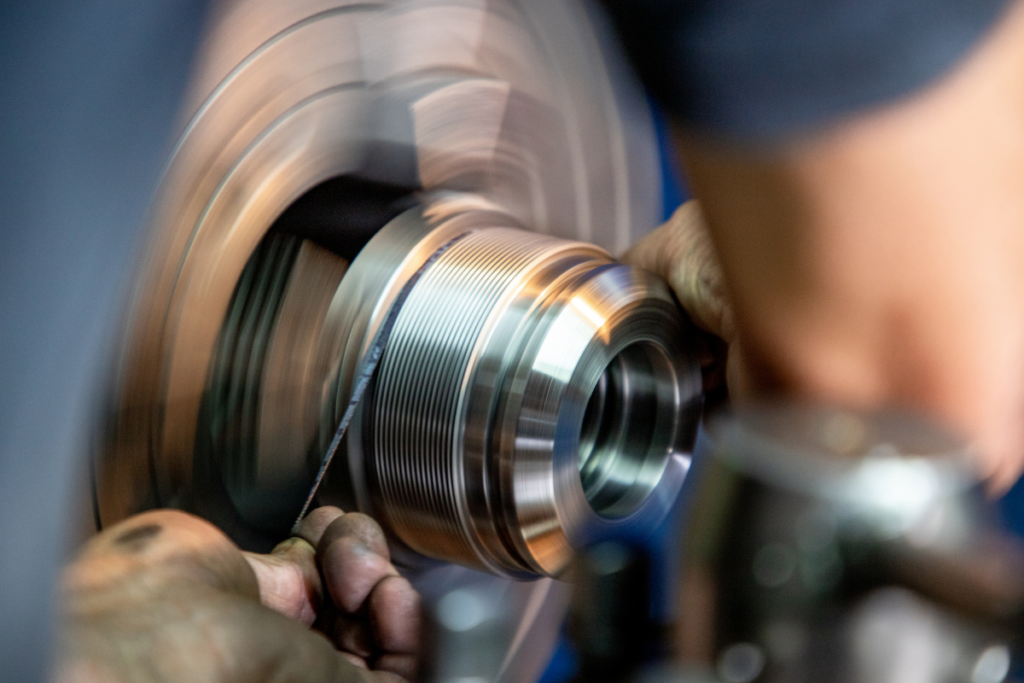
Creating a functional, high-quality component from a piece of metal involves several processes that, although executed sequentially, must work together seamlessly to deliver the best results possible.
This is also true for the fasteners used to hold the single component together or integrate it into the final assembly. Burrs, uneven surfaces, and poor fastener seating can compromise product performance and shorten its life.
This is where CNC countersinking and tapping come into play, ensuring cleaner, stronger, and more reliable threaded connections that withstand the demanding operating conditions common in off-road vehicle applications.
Understanding CNC Countersinking
Countersinking is the process of machining a conical opening at the top of a drilled hole. The operation is typically performed using a specialized countersink tool that removes a small amount of material around the hole entrance.
In some applications, the primary purpose of countersinking is to create a recess for a flat-head fastener. However, for many tapped-hole applications, the countersink serves as a lead-in feature that prepares the hole for threading and assembly.
The chamfer created by the countersink benefits the hole in three significant ways:
- Removes Burrs
Drilling operations often leave a raised, sharp, and jagged edge (burr) at the top of the hole. Any burrs that remain in place can interfere with the tap as it enters the hole, creating a thread that may be less consistent. Excessive burr formation can also increase tool wear. Countersinking shears this material off safely, enhancing subsequent machining operations and final assembly performance.
- Improves Threading
If a hole is to be tapped, creating a chamfer provides a smoother transition into the threaded section of the hole, preventing it from catching on a sharp edge or curling the material into a weak thread.
- Aids Fastener Alignment
For bolt or screw holes, the angled bevel acts as a funneled lead-in, making it much easier to guide the screw in perfectly and preventing the threads from getting crossed, which would compromise the attachment.
At Arrow Off-Road, we use CNC technology to create countersinks of exceptional accuracy, ensuring that the chamfer angle, depth, and concentricity remain consistent across large production runs.
What Is CNC Tapping?
After the countersinking process is complete, CNC tapping comes next. This is the process of cutting or forming internal threads within a pre-drilled hole, allowing bolts, screws, studs, and other threaded fasteners to securely attach to the component. The spindle is then reversed, and the tap backs out of the hole.
CNC technology at Arrow Off-Road plays a critical role in this process as well, automatically synchronizing the spindle’s rotation with the feed rate to produce consistent, precise threads across large production runs without manual intervention. It also eliminates the risk of poorly formed threads, which can lead to stripped holes, loose connections, assembly failures, and premature wear.
The Benefits Of CNC Countersinking And CNC Tapping
As with many interconnected processes in metalworking, the relationship between CNC countersinking and CNC tapping supports seamless precision machining operations. It also delivers other benefits to the overall project, including:
Improved Assembly Efficiency
CNC countersinking and tapping enable assembly technicians or automated assembly machines to install fasteners faster and with greater predictability. This increase in efficiency also improves production scheduling by reducing assembly bottlenecks and the likelihood of rework.
Supports Long-Term Durability
Precision countersunk and tapped holes helps the component everyday real-world stresses such as heavy loads, constant vibration, impact forces, dirt, moisture, and temperature fluctuations by providing better fastener seating and more consistent load distribution. It also helps reduce localized stress concentrations that can lead to wear or fatigue over time, and protects joint integrity where vibration and dynamic loading are constant concerns.
Corrosion Prevention
Precision countersinks allow for tighter seals, flush bolts, and cleaner surface coverage, mitigating the risk of voids and uneven paint accumulation during parts coating. Evenly-applied coating protects the metal from rust, extending the product’s lifespan and optimizing your investment.
Enhances Product Quality
Moving parts between different manual workstations can introduce clamping variations and handling damage. However, using CNC machining systems to combine drilling, countersinking, and tapping on a single machine ensures that every feature is perfectly concentric with the original hole, delivering higher-quality results, even for complex or intricate components.
Read More: How Arrow Off-Road Became A Leader In Off-Road Parts & Equipment
Arrow Off-Road: Your Trusted Precision Machine Partners For Industrial Parts and Components
When you need high-quality metal parts and equipment fabricated with the latest precision machining technology, contact the experts at Arrow Off-Road.
Our highly skilled technicians specialize in supporting OEMs’ off-road parts and equipment projects with products that perform reliably and efficiently in the field, even under the harshest conditions.
When you’re planning your next fabrication project, call our team first. You’ll be glad you did!
Arrow Off-Road: CNC Manufacturers In Canada Delivering Quality Parts and Components To Global OEMs
Partner with Arrow Off-Road for precise machining, welding, and fabrication solutions customized to your requirements and application. Request a quote for your next project to experience the Arrow difference in quality, precision, and service.